

Passing Technical Requirements for Nintendo Switch 2 in 2026
Passing Technical Requirements for Nintendo Switch 2 in 2026
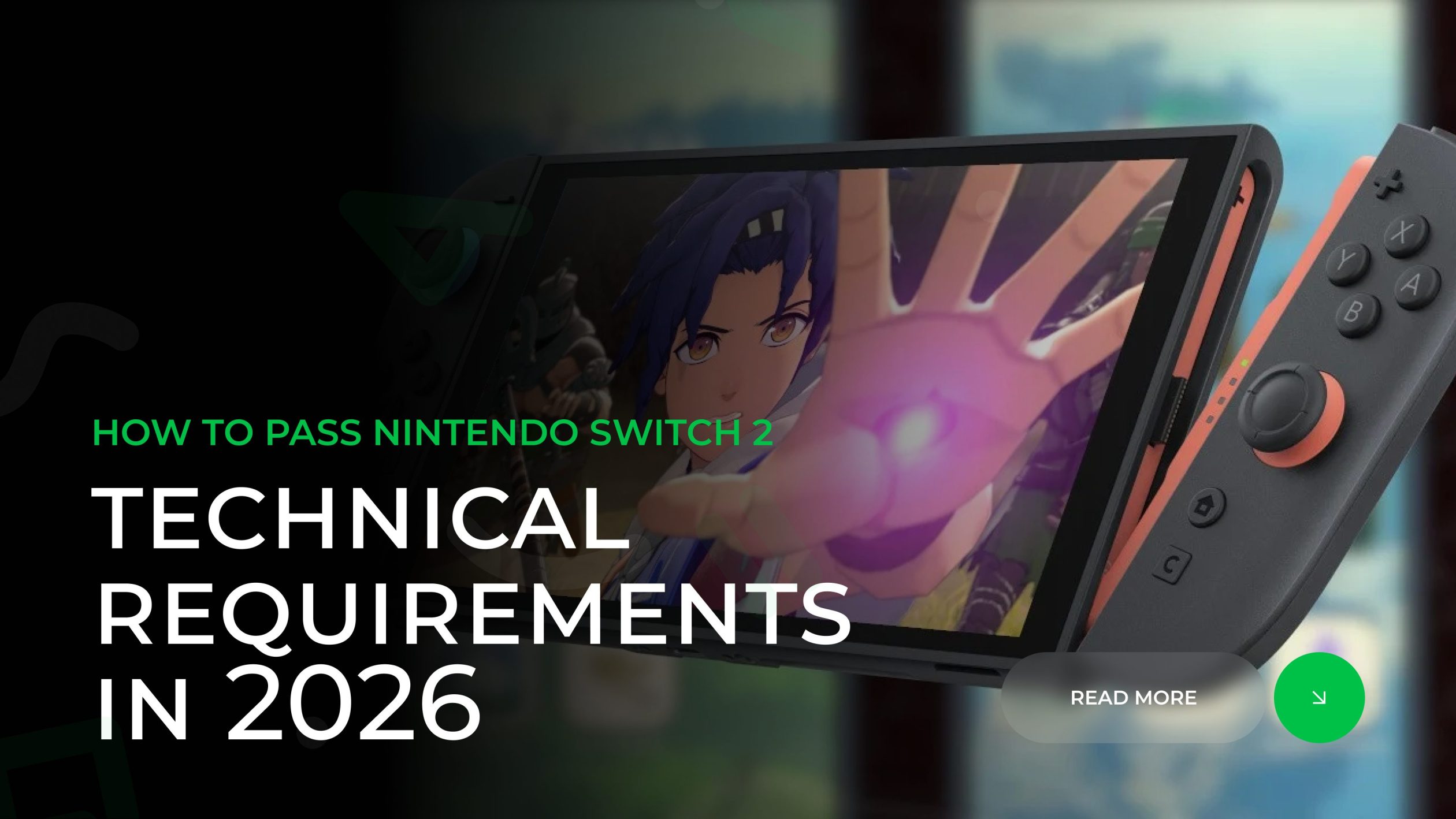
Releasing a game on Nintendo Switch 2 in 2026 is both an opportunity and a technical challenge. Nintendo’s next-generation hybrid platform delivers more power, modern rendering capabilities, and higher performance ceilings — but certification remains as strict as ever.
Many studios underestimate what “technical requirements” truly mean. It’s not just about hitting a framerate target or avoiding crashes. Passing certification on Switch 2 requires a deep understanding of platform behavior, hardware limitations, compliance rules, and — most importantly — structured, console-focused testing.
This guide walks through what it really takes to pass Nintendo Switch 2 technical requirements in 2026, based on industry best practices and console QA expertise.
Understanding the Switch 2 Environment
Switch 2 represents a significant evolution over the original Switch architecture. With a more powerful NVIDIA-based chipset, support for higher resolutions in docked mode, improved handheld performance, and modern rendering features such as AI upscaling, the platform closes much of the technical gap between handheld and home consoles.
But more power does not mean fewer constraints.
Switch 2 is still a hybrid system. Your game must behave flawlessly across:
- Handheld mode
- Docked mode
- Dynamic transitions between both
The certification process evaluates how your game responds to real-world usage patterns, not just ideal lab conditions. Players dock and undock mid-session. They suspend the console during gameplay. They switch user accounts. They disconnect controllers. Every one of these scenarios is part of technical validation.
Failing to handle even one properly can result in rejection.
Certification Is a System-Level Evaluation
When developers talk about “technical requirements,” they often focus on gameplay stability. Nintendo looks far beyond that.
Certification examines how your game integrates with the operating system. This includes proper handling of:
- Home button interruptions
- Sleep and wake cycles
- Error messaging
- Network disruptions
- Save data behavior
- Parental control restrictions
Your game must respect system rules at all times. If a player presses the Home button during an autosave, the system must not freeze. If the console battery dies mid-session, save data must remain intact. If a controller disconnects, the game must respond gracefully.
These are not edge cases. They are mandatory platform expectations.
Performance Expectations in 2026
Switch 2 offers stronger GPU performance and improved memory capacity compared to its predecessor. However, certification is not about theoretical capability — it’s about consistent delivery.
Your title must maintain stable performance under stress.
This includes testing:
- Heavy combat scenes
- Large open environments
- Multiplayer synchronization
- Particle-heavy effects
- Streaming-intensive transitions
A game that averages 60 FPS but regularly dips into unstable ranges during intense gameplay may be flagged. In handheld mode, thermal limits and power scaling introduce additional complexity. Long play sessions can expose bottlenecks that short tests never reveal.
Performance validation must include extended runtime testing, memory leak monitoring, and GPU/CPU profiling on actual dev hardware.
Optimizing late in production is one of the biggest risks console teams face. Performance discipline should begin at prototype stage, not weeks before submission.
The Critical Role of Game Testing
Passing Nintendo Switch 2 technical requirements in 2026 is fundamentally a QA challenge.
Many certification failures do not happen because developers lack skill. They happen because teams treat console testing like PC testing. The environments are not comparable.
Console QA must cover several dimensions simultaneously:
Functional Testing Beyond Gameplay
Testing is not limited to mechanics and bugs. QA must simulate platform interactions constantly.
Examples include:
- Docking and undocking during cutscenes
- Switching user profiles mid-session
- Forcing low storage conditions
- Interrupting network connections
- Disconnecting Joy-Cons during multiplayer
These behaviors expose system-level weaknesses that rarely appear in traditional gameplay passes.
Compliance Testing
Nintendo maintains strict platform compliance standards. These include correct terminology, required warning screens, button icon consistency, and correct system prompt usage.
If your button prompts mismatch Nintendo’s official naming conventions, you risk rejection.
If your error messaging does not align with platform standards, you risk rejection.
If parental controls are bypassed unintentionally, you risk rejection.
Compliance testing requires detailed checklists and console experience. It is one of the most underestimated aspects of certification preparation.
Save Data Integrity
Save data handling is one of the most sensitive technical areas.
Your game must:
- Prevent corruption during interruptions
- Handle multiple user profiles
- Display appropriate messaging when storage is full
- Maintain compatibility across firmware updates
QA teams should actively attempt to break the save system. Forced shutdowns, rapid suspend/resume cycles, and storage edge-case scenarios must all be tested.
Docked vs Handheld Experience Validation
Switch 2’s hybrid nature creates UX complexity.
Interface readability must be validated on both a television screen and a portable display. Fonts that look clean on a 4K TV may be unreadable in handheld mode.
QA should verify:
- UI scaling
- HUD clarity
- Touchscreen accuracy (if used)
- Motion control responsiveness
- Vibration and haptic behavior
Certification reviewers evaluate user experience holistically. Poor handheld readability can delay approval.
Multiplayer and Online Stability
If your game includes online functionality, certification becomes more demanding.
Network handling must include:
- Graceful reconnection logic
- Clear communication during server failures
- Proper handling of NAT restrictions
- No infinite loading loops
Switch 2 players expect stable online sessions. Nintendo expects robust error recovery.
QA should simulate unstable Wi-Fi conditions, forced disconnects, and lobby interruptions to validate real-world resilience.
Regression Testing Before Submission
Firmware updates and SDK revisions can introduce unexpected conflicts. A feature that worked two months ago may fail under the latest system update.
Regression testing before submission is critical.
This means retesting:
- Suspend/resume behavior
- Controller reconnection
- Save handling
- Performance stability
Skipping regression is one of the fastest ways to receive a rejection report.
Why First-Time Pass Matters
Certification is not just a technical milestone. It is a production risk factor.
Each failed submission can delay release windows by weeks. Marketing campaigns, publisher agreements, and storefront scheduling are often tied to specific dates.
Multiple rejections increase costs and strain partnerships.
Studios that invest in structured console QA early in development dramatically improve their first-time pass rate.
Building a 2026 Switch 2 Certification Strategy
Successful teams treat platform readiness as a parallel production stream.
Development, optimization, and QA should evolve together.
Console-focused QA specialists should be involved before beta stage. Performance validation should be continuous. Compliance checklists should be reviewed throughout development, not just at the end.
Testing on real devkits is non-negotiable. Emulator-based confidence is not enough.
Studios that simulate certification conditions internally — including compliance audits and stress passes — significantly reduce submission risks.
Final Thoughts
Passing technical requirements for Nintendo Switch 2 in 2026 is not about luck. It is about preparation, discipline, and platform awareness.
Switch 2 gives developers more power and more creative freedom than its predecessor. But Nintendo’s expectations for polish, stability, and system integration remain uncompromising.
Games that pass certification smoothly share common traits:
- Early performance optimization
- Structured console QA
- Deep compliance knowledge
- Real hardware testing
- Thorough regression cycles
In the competitive console market, technical excellence is not optional — it is foundational.
Certification is not the end of development. It is proof that your game meets the standards of a global platform.
And in 2026, on Switch 2, those standards are higher than ever.